GHK-Cu
Dermal ResearchCAS 89030-95-5
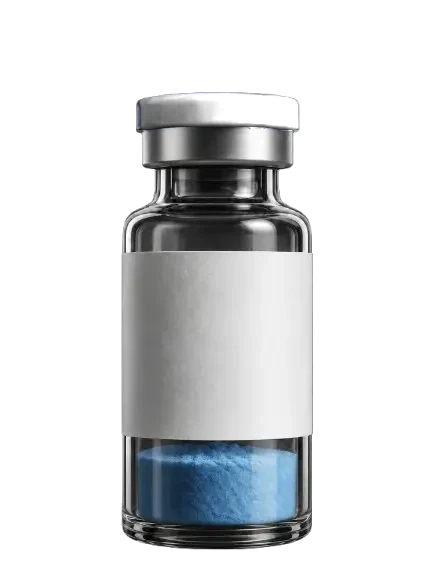
Available sizes: 50 mg, 100 mg
GHK-Cu is three amino acids — glycine, L-histidine, L-lysine — bound to a copper(II) ion. It was isolated from human plasma in 1973 and subsequently identified in saliva and urine. Measured plasma levels fall substantially between early adulthood and later life, and that observation is the origin of most of the research programme around it.
The copper is not incidental. GHK has high affinity for Cu(II) and the complex is the active species in most of the published work: the peptide functions as a delivery vehicle for a metal that many enzymes require and that is toxic when unchaperoned.
Matrix gene expression. Broad transcriptional studies report changes across large numbers of genes involved in matrix assembly and remodelling.
Collagen and glycosaminoglycan synthesis. Fibroblast culture work measuring production of structural proteins directly.
Antioxidant enzyme systems. Superoxide dismutase depends on copper, so a copper carrier has a plausible route into oxidative stress research.
Matrix metalloproteinase balance. Remodelling depends on the ratio of MMPs to their inhibitors, which GHK-Cu is studied against.
Hair follicle biology, where the related tripeptide AHK-Cu is more commonly used.
The copper complex gives reconstituted GHK-Cu a distinct blue colour. That is the compound, not a contaminant, and it is the reason vials of the copper peptides look different from every other lyophilised powder in this catalogue.
AHK-Cu is the closely related copper-binding tripeptide, studied more in follicle work than in matrix work. GHK-Cu is a constituent of the GLOW Stack and KLOW Stack preparations, and SNAP-8 appears in the same topical literature through an unrelated mechanism.
Certificates of Analysis are published for tested products and batches. A certificate is a batch-specific record: it reports what was measured, by which method, on a stated date, against a batch identifier. It is evidence about the sample analysed at the time of analysis, and it is silent on attributes it does not list and on what has happened to the material since.
The batch number is the field that connects the document to a physical vial. Where the identifier on a vial does not appear on a certificate, the certificate does not describe that vial, however thorough the analysis behind it was. Batch records can be searched directly, and the guides below explain what each field establishes and what it does not.
Supplied for laboratory research use only. Not for human or veterinary use.